The Self-help Resource Center for Vision LossAre You AWARE? July 2008
Vol 2, Issue 3, July 2008
Special Issue on Orientation and Mobility
Maureen A. Duffy, Editorial Director maureen.duffy@visionaware.org
IN THIS ISSUE....
- A Message from our President, Anne Yeadon
- News from VisionAWARE
- An Introduction to Orientation and Mobility by Dona Sauerburger
- What Is Orientation and Mobility?
- Learning to Travel Safely and Independently with Vision Loss
- Learning to Use Non-Visual Information
- Learning to Travel with Both Hearing and Vision Loss
- How to Walk with a Guide
- What will people think about me if I use a white cane?
- Does the cane have to be white to be effective?
- What type of cane should I use?
- How do I learn to use a cane?
- Can you tell me about guide dogs?
- Resources and Links for Orientation and Mobility
A Message From Our President, Anne Yeadon
Greetings VisionAWARE readers and welcome to our Special Issue on Orientation and Mobility prepared by our guest author Dona Sauerburger, M.A., COMS®, Orientation and Mobility Specialist. Dona is a Certified Orientation and Mobility Specialist, and provides itinerant orientation and mobility services to blind and visually impaired adults and teenagers in Maryland and suburban Washington, DC. She earned a Master's degree specializing in Orientation and Mobility (O&M) from Western Michigan University and has a special interest in working with people who are deaf-blind.
Her book, Independence Without Sight or Sound: Suggestions for Practitioners Working with Deaf-Blind Adults, published by the American Foundation for the Blind, received the C. Warren Bledsoe Publication Award. You can learn more about her book, including ordering information, at the VisionAWARE Bookstore. She is also the recipient of the prestigious Lawrence Blaha Award for outstanding contributions to the field of Orientation and Mobility.
This Special Issue of the Are You AWARE? newsletter addresses safe, efficient, and effective travel skills for people who are blind or have low vision, also called orientation and mobility (O&M).
Many of our friends and colleagues outside the field of vision rehabilitation do not know what ‘orientation and mobility’ is, nor what an O&M Specialist does. This special issue on orientation and mobility will hopefully provide you with an understanding of the importance of orientation and mobility in enhancing quality of life and personal independence – for all who live with vision loss.
To locate an Orientation and Mobility Specialist in your home area, see our state-by-state listing of vision rehabilitation services, which includes information about Orientation and Mobility instruction.
If you have questions or experiences to share on this topic, or if you found this special issue newsletter informative, we would very much like to hear from you. From the VisionAWARE team we send best wishes for a happy, healthy, safe, and fun summer. Anne Yeadon, President, AWARE anne.yeadon@visionaware.org
Reader Feedback
“I am an occupational therapist. I just started working at a center that provides services and classes for adults with vision loss. We recently updated our Life Skills program, and I am in the process of developing adaptive recreation-based classes. I just wanted to thank you for your wonderful web site. It has been a great resource for me in getting ideas for adaptive classes that we might want to try.” ~ Rose Visser, OTR, Life Skills Therapist, Badger Association of the Blind and Visually Impaired, Inc.
“I am ever so grateful for this information! I am very glad that there are so many aids now for the various concerns AND that your web site has SO much information. I will be sharing it with friends who have various concerns. Again, many thanks for your work on behalf of people who are blind!” ~ L. L., Anchorage, Alaska
An Introduction to Orientation and Mobility by Dona Sauerburger, M.A., COMS®, Orientation and Mobility Specialist
Dona Sauerburger, M.A., COMS
Dona is a Certified Orientation and Mobility Specialist, and provides itinerant orientation and mobility services to blind and visually impaired adults and teenagers in Maryland and suburban Washington, DC. She earned a Master's degree specializing in Orientation and Mobility (O&M) from Western Michigan University and has a special interest in working with people who are deaf-blind.
Her book, Independence Without Sight or Sound: Suggestions for Practitioners Working with Deaf-Blind Adults, published by the American Foundation for the Blind, received the C. Warren Bledsoe Publication Award. You can learn more about her book, including ordering information, at the VisionAWARE Bookstore. She is also the recipient of the prestigious Lawrence Blaha Award for outstanding contributions to the field of Orientation and Mobility.
What is Orientation and Mobility?
Orientation and Mobility (O&M) is a profession specific to blindness and low vision that teaches safe, efficient, and effective travel skills to people of all ages:
- "Orientation" refers to the ability to know where you are and where you want to go, whether you’re moving from one room to another or walking downtown for a shopping trip.
- "Mobility" refers to the ability to move safely, efficiently, and effectively from one place to another, such as being able to walk without tripping or falling, cross streets, and use public transportation.
Orientation and Mobility Specialists
An Orientation and Mobility (O&M) Specialist provides instruction that can help you develop or relearn the skills and concepts you need to travel safely and independently within your home and in the community. O&M Specialists provide services across the life span, teaching infants and children in pre-school and school programs, as well as adults in a variety of community-based and rehabilitation settings.
The Academy for Certification of Vision Rehabilitation and Education Professionals (ACVREP) offers certification for vision rehabilitation professionals, including O&M Specialists. A Certified Orientation and Mobility Specialist (COMS) must adhere to a professional Code of Ethics and demonstrate knowledge and teaching skills in areas such as the following:
- Sensory development, or maximizing all of your senses to help you know where you are and where you want to go
- Using self-protective techniques and human guide techniques to move safely through indoor and outdoor environments
- Using a cane and other devices to walk safely and efficiently
- Soliciting and/or declining assistance
- Finding destinations with strategies that include following directions and using landmarks and compass directions
- Techniques for crossing streets, such as analyzing and identifying intersections and traffic patterns
- Problem-solving skills to determine what to do if you are disoriented or lost or need to change your route
- Using public transportation and transit systems.
Orientation and Mobility for Adults
If you are an adult who is blind or has low vision, you may have experienced several – or all – of the following O&M problems and concerns:
- Bumping into furniture, such as a corner of your coffee table
- Falling or tripping on an obstacle or step that you cannot see
- Feeling unsafe when crossing streets
- Becoming lost or disoriented, either inside your home or out in the community.
An O&M Specialist can work with you to plan an individualized program of instruction that reflects your personal needs, skills, and goals, which can include any or all of the following goals:
- Getting around safely inside your home
- Learning the route to your mailbox
- Taking a walk around the block
- Shopping independently
- Using public transportation to get to work
- Traveling around the world independently
O&M instruction is usually conducted on a one-to-one basis, and can take place either in the community where you live and/or work (called “itinerant O&M”) or at a rehabilitation center (called “center-based O&M”).
To locate an Orientation and Mobility Specialist in your home area, see VisionAWARE's state-by-state listing of vision rehabilitation services, which includes information about Orientation and Mobility instruction.
You can read more about O&M Specialists and O&M instruction at the Orientation and Mobility Division web site of the Association for Education and Rehabilitation of the Blind and Visually Impaired.
History of Orientation and Mobility
The profession of Orientation and Mobility began to develop during and immediately after World War II, when soldiers who had been blinded in battle were sent to recuperate at Valley Forge Army General Hospital before entering Avon Old Farms Convalescent Hospital, the U.S. Army’s former experimental rehabilitation center for blind soldiers in Avon, CT.
In order to better serve the large number of blind soldiers who required special training and services, the military recruited Richard E. Hoover, an army sergeant, who was assigned to the center for the treatment of blinded soldiers at Valley Forge Army Hospital in 1944. During the same year, Russell Williams, who was blinded by enemy action in France, received medical rehabilitation at the Valley Forge Army Hospital, and in 1947, C. Warren Bledsoe joined the Hospital. Both Hoover and Bledsoe had previously worked at the Maryland School for the Blind. These three men made significant contributions to the development of a new profession: Orientation and Mobility (O&M).
The blinded soldiers were highly motivated to be successful, and Richard Hoover believed that the traditional strategies taught and used to travel independently were inadequate. In response, he developed a technique for using a cane that is lightweight and longer than support canes. This technique and cane revolutionized independent travel for blind people and are still used today.
To learn more about the development of the orientation and mobility profession, see Orientation and Mobility Living History: Where Did Our O&M Techniques Come From?
To learn more about the U.S. Army’s former rehabilitation program at Avon Old Farms Convalescent Hospital, see Old Farms Reflections at the Blinded Veterans Association web site.
Learning to Travel Safely and Independently with Vision Loss
Can I learn to travel safely and independently if I’ve lost some or all of my vision?
If you've had vision throughout your life, you've probably used it to obtain most or all the information you need to get around. Now that you have a vision loss, however, you may wonder how you can accomplish the things you used to do by looking, such as
- Locating the doorway to your bedroom or basement
- Avoiding an obstacle in your path, either indoors (a coffee table) or outdoors (a trash can lid on the sidewalk)
- Detecting the edge of a curb or step so that you don’t trip or fall
- Locating a store or an office building
- Using buses and crossing streets
All of these tasks can be done safely and efficiently by using what is called “non-visual information.” Using non-visual information means using your other senses, such as hearing, touch, smell, and the perception of your body’s position and movement. You can use information from these senses to determine where you are and what is happening around you. Some examples of using non-visual information are as follows:
Hearing
Everyday sounds can provide many clues about your surroundings, including:
- The hum of the refrigerator in your kitchen
- Traffic sounds in the street outside your home
- Pedestrians passing you on the sidewalk
O&M instruction can teach you to:
- Use the hum of your refrigerator or traffic sounds as “landmarks” to help you determine where you are, both inside your home and outdoors;
- Determine the direction of a sound and its distance from you;
- Use traffic and pedestrian sounds to determine the width of a street, the location of a traffic signal or stop sign, and the direction to face when crossing the street;
- Use echolocation to sense objects (such as a tree, a wall, or a building) in your environment by learning to interpret the echoes and sounds reflected from those objects.
- To experience echolocation yourself, try closing your eyes and making a sound while you move your head in closer to a wall. Notice how the sound changes as you move closer to the wall. Some people describe the sound as more “echo-y,” while other people “sense the presence” of the wall in ways they can’t describe and are surprised to discover it is their hearing that is “sensing” the wall.
- Echolocation used to be called “facial vision” because the sensation often seems to be in the perception of the skin rather than the ears.
For more information about hearing, see Maximize Your Sense of Hearing and All About Hearing and Hearing Loss.
Touch
The sense of touch can provide many clues about your surroundings, including:
- Textures under your feet indoors, such as the carpet in your living room and the linoleum or tile in your kitchen
- Textures under your feet outdoors, such as grass, asphalt, or broken concrete
- The warmth of the sun on your face and clothing
O&M instruction can teach you to:
- Determine when you’ve entered the living room by feeling the carpet under your feet
- Determine when you’ve entered your driveway by feeling pavement or gravel under your feet or cane
- Determine the direction you’re facing by feeling the warmth of the sun on your face and body
For more information about the sense of touch, see Maximize Your Sense of Touch.
Smell
The sense of smell can provide some clues about your surroundings, including:
- The scents of deodorizers, cleaning supplies, sawdust, pizza, leather, and baked goods
O&M instruction can teach you to:
- Use a distinctive scent to help you determine what kind of room you are entering (a bathroom or a workshop) or what kind of store you are in (a pizza shop, a shoe store, or a bakery).
For more information about the sense of smell, see Maximize Your Sense of Smell.
The Kinesthetic Sense
Kinesthesia refers to the awareness of your body’s movement and position, for example when you bend, reach for a door handle, walk, or turn around.
Kinesthesia can provide many clues about your surroundings, including:
- The movement of your body while you walk
- The position of your cane or your guide’s arm as you hold it
- The distance you’ve walked
O&M instruction can teach you to:
- Accurately judge (without counting steps) how far to walk in order to reach a hallway or door, a store, or a bus stop
- Notice if you’re walking along the slope of a driveway
- Anticipate steps and curbs by noticing when your guide has moved upward or downward or your cane has dropped down over an edge or a curb.
Learning to Use Non-Visual Information
I’m able to see some things, but what I see is not always reliable. How can I learn to use non-visual information?
If you’ve had vision for most of your life, you’ll probably tend to trust and rely upon visual information. If you lose some of that vision, you may often still try to rely on it and ignore helpful non-visual information, such as touch and sounds. You may believe your eyes, even when your vision is unreliable or misleading, instead of using non-visual information which is more accurate and helpful.
When your eyes tell you one thing, but a sound, a touch, or your own position or movement tells you another, which do you believe?
Here are some examples:
1. When walking with someone using the human guide technique, if your eyes are telling you the ground looks smooth and unbroken as far you can see:
Would you notice or observe:
- That your guide has taken a step down from the curb?
If you do notice, which will you believe?
- The faulty information that your eyes are providing about the ground being flat?
- The information provided by the downward movement of your guide that indicates a curb?
or
2. When walking toward a corner that you know has a stop sign, if your eyes are telling you that the sidewalk looks as if it makes a sharp turn to the right, which implies that you’ve reached the corner:
Would you notice or observe:
- That the traffic on the street beside you does not stop?
If you do notice, which will you believe?
- The faulty information that your eyes are providing about reaching the corner?
- The information provided by the sounds of traffic that is still moving?
or
As you gain experience during O&M instruction, you will begin to notice and use more and more non-visual information, which can help you learn to verify (or disregard!) the incomplete or inaccurate information you may be receiving visually.
Some of the ways this can be taught are:
Strategy #1: Your orientation and mobility instructor points out or asks you to notice non-visual information as you walk together:
- The sound of traffic on a busy highway in the distance can help you know the direction you’re facing.
- The slope of the sidewalk as it crosses a driveway may change abruptly, indicating that you’re at the edge of the street.
Strategy #2: Under the guidance of an orientation and mobility specialist, you wear a blindfold or close your eyes:
- This makes it easier to notice sounds and slopes and textures underfoot, as well as the sun’s warmth, which can help you determine which direction you’re facing.
- You will, however, need additional practice to continue to notice and use non-visual information after you take off your blindfold and/or open your eyes.
Strategy #3: Under the guidance of an orientation and mobility specialist, you cover the lower portion of your eyeglass lenses so that you’re unable to see what is on the ground in front of you:
- With this covering, you are still able to see what is happening around you, but you cannot see the cane and your feet. This strategy can help you learn to focus on the information that the cane is providing.
For more information about these techniques, see The Use of Visual Occlusion in Orientation and Mobility Instruction at the Orientation and Mobility Division web site of the Association for Education and Rehabilitation of the Blind and Visually Impaired.
For more information about O&M training in non-visual skills and techniques, see Examples of Strategies for Teaching Non-Visual Skills.
Learning to Travel with Both Hearing and Vision Loss
I have a hearing loss as well as a visual impairment. Can I still learn to travel safely and independently?
People who have a hearing loss as well as a visual impairment – and people who are profoundly deaf and totally blind – can travel in their communities, commute to work, and even travel around the world independently.
Communicating with Vision and Hearing Loss
A primary orientation and mobility (O&M) challenge for individuals who cannot hear or see well is learning to communicate effectively with people who can provide help or information, such as store personnel, bus drivers, police, and pedestrians.
During O&M training, you can learn which communication strategies will work for you and have the opportunity to practice a variety of communication techniques while your O&M instructor observes and provides feedback.
One useful communication technique is to use a card with a message written on it. For example, to communicate the need to get across a street, you can use a street-crossing card:
A street-crossing card for deaf-blind individuals (credit: Dona Sauerburger and Gene Bourquin)
- The 8”x 4” laminated card has a tab centered at the bottom so that the individual can hold it without covering the text. The card is attached to a cord that is worn around the neck.
- For more information about using a street-crossing card, see Effective Use of Cards for Soliciting Assistance to Cross Streets.
For more information about communication and alternatives to street-crossing for people who are blind or have low vision in addition to a hearing loss, see Teaching Deaf-Blind People to Communicate and Interact with the Public and Getting Across the Street with Visual and Hearing Impairments.
About Hearing Aids
Many newer digital hearing aids are programmed to magnify speech and eliminate background noise, which can make it more difficult to identify and localize traffic sounds and other environmental “orientation clues.”
If you wear hearing aids, it’s important to let your audiologist know that you need to hear a wider range of environmental sounds, such as traffic noise. Once your audiologist is aware of your O&M needs, he or she can program your digital hearing aids so that you can identify and localize these important environmental sounds more accurately.
For more information about hearing and hearing aids, see About Hearing and Hearing Loss and About Hearing Aids.
How to Walk with a Guide
Hold the guide's arm just above the elbow, similar to the way you hold a cup (credit: Dona Sauerburger)
How can I walk more comfortably and effectively with a guide?
There may be times when you find that it is faster and easier to get somewhere by walking with another person who will act as a “guide.” The following tips can be helpful if you use a guide to help you walk to your mailbox, visit a neighbor, or shop in a mall or grocery store:
- Take the guide’s arm and hold it gently but firmly just above the elbow, with the same grasp you would use to hold a glass of water (thumb on one side of the guide’s arm and fingers on the other side). This grip will allow you to receive the greatest amount of feedback from the guide’s movements.
- If you use a cane, take the guide’s arm with your free hand.
- Tell the guide if his or her pace is too fast for you. It’s important that you walk at a pace that is comfortable for both of you.
- Follow the guide’s movements and stay half a step behind the guide when you walk together. A good way to do this is to keep your elbow close to your body. If you walk in this position, instead of side-by-side, you will have time to react to hazards or obstacles in your path. However, it usually requires training and practice to follow the movement of your guide to anticipate steps and stairs, especially if you have some useful vision.
- Instruct your guide to approach curbs and steps head-on, rather than at an oblique angle, so that you know where to expect the edge of the curb or step in relation to your guide’s – and your own – body.
- Your O&M instructor can teach you additional techniques and signals that you and your guide can use to go through doorways and walk single file through narrow spaces.
The correct position: half a step behind the guide (credit: Dona Sauerburger)
For additional information about self-protective mobility techniques, see Learn To Move Safely Within Your Home, Lower Body Protective Technique, Upper Body Protective Technique, Trailing Technique, and Finding a Dropped Object.
What will people think about me if I use a white cane?
If you are embarrassed to be seen with a cane, consider what your own reaction might be if you saw someone else walking with a cane or a guide dog.
When I’ve asked other people with low vision about their reactions to people who are traveling with a cane, they often say that the person with the white cane must have a lot of courage and savvy to get around when he or she can’t see well. Many people also say that they would probably offer to help the person who is using a cane. When people stop to think about their own feelings about blindness, many are no longer embarrassed about being seen with a white cane.
You may also worry about being watched or stared at when you walk with a cane. To address this concern, I often observe people’s reactions and behavior when they pass an individual who is carrying a cane; sometimes I’ll even ask about their personal reactions to blindness.
I have learned that very few people even glance at the person using a cane. When I talk with people passing by, they often express admiration for the courage and competence of the person who is using the cane and wondered how they managed.
Some people who have low vision worry that if they carry a white cane, people will think they are “cheating” and that only people who are totally blind can use a white cane. Although this is a common belief, the fact is that the majority of people with vision problems (including those who use a white cane) have some remaining useful vision. The American Foundation for the Blind estimates that 85% of all individuals with eye disorders have some remaining sight; only about 15% are totally blind. You can learn more about the definitions of legal blindness and low vision at Low Vision Terms.
“White cane laws” in the United States prohibit people from carrying a white cane unless they have a visual impairment. In Maryland, for example, only people who are “blind or partially blind” can carry a white cane, and in New York, it is people who are “blind or visually impaired.” This means that if you have a visual impairment or are “partially blind,” even if you are not totally blind, you are permitted to carry a white cane.
Many people who live or travel in high-risk communities worry that carrying a white cane will make them more vulnerable to attack. At present, there is no research indicating that people with white canes are more vulnerable or likely to be targets for muggers.
However, it is often said that people seem less vulnerable when they appear confident and assertive. If that is true, then a person with a white cane who is walking quickly – and with confidence – may appear less vulnerable than a person who is not using a cane and is walking tentatively with his or her head down, trying to see the ground, perhaps tripping and stumbling on uneven pavement.
For more information about coping with vision loss, see Coping with Your Emotions When You lose Your Vision.
Does the cane have to be white to be effective?
When used properly, a cane can provide information and protection regardless of its color – it does not have to be white to be effective. Most canes used by blind people are white, but they are also available in red, black, yellow, and blue.
Canes from AmbuTech are now available in several colors (credit: AmbuTech)
The blind character portrayed by Al Pacino in the film “Scent of a Woman” inspired the development of AmbuTech’s solid black cane.
However, only a white cane identifies the user as a person who is blind or has low vision. This can be an important consideration when crossing streets and requesting information from store clerks, bus drivers, and the general public. It’s likely that people will be more willing to help if they realize you’re asking for information because you are blind or have low vision.
About “White Cane Laws”
Many people are under the impression that each state’s White Cane Law contains a provision that requires drivers to stop for, and/or yield to, pedestrians who are carrying white canes. This is not correct. The laws in each state vary widely and drivers do not always reliably stop for pedestrians who carry white canes.
When drivers see pedestrians who are carrying white canes:
- Some states require that drivers yield.
- Some states require drivers to come to a full stop.
- Some states require only that drivers exercise caution when in the presence of pedestrians with white canes.
- Some states provide no special rights and protections to pedestrians who are carrying white canes that are not provided to all pedestrians.
Check your state’s White Cane Law to determine the language that describes driver and pedestrian rights and responsibilities.
For more information about the history of White Cane Laws in the United States, see History of White Cane Safety Day at the American Council of the Blind web site.
What type of cane should I use?
One type of support cane (credit: Wikipedia)
Over the centuries, from the first time someone fashioned a twig into a cane or pole, people have developed a wide variety of canes to aid with walking. Today, in addition to walking sticks and ski poles, two types of canes are commonly used:
- The support cane, which provides physical stability. A support cane that is white can identify you as a person who is blind or has low vision.
- What I call the probing cane (more commonly called a “white cane” or a “long cane”) probes for and locates obstacles in your path of travel.
A Support Cane Should:
- Be strong enough to support your weight. This usually means that a support cane is not lightweight.
- Be short enough to rest your hand on top while you hold it close to your body.
- Have a tip that grips the floor and does not slide.
One type of "probing" cane (credit: Wikipedia)
A Probing Cane Should:
- Be lightweight so that you can hold and move it in front of you without becoming tired. This usually means that a probing cane is not strong.
- Be long enough to reach ahead and warn you about obstacles and stairs.
- Have a tip that can slide easily along the ground.
A support cane and a probing cane are designed differently and serve very different purposes, so the choice of which cane to use will depend on your needs:
- If you need to know what is on the ground in front of you:
- If you need a cane to help you know what is on the ground in front of you, it is recommended that you use a probing cane.
- Please note: If you use a support cane to probe the ground ahead of you, it is usually not possible to reach far enough ahead without leaning forward. This is harmful for your posture and appearance and is also risky and dangerous, particularly when approaching descending stairs. If you miss your footing or lose your balance while you are leaning forward, you are likely to fall forward and tumble down the stairs.
- If you need a support cane AND need to know what is on the ground in front of you:
- If you can’t see well enough to know what is on the ground in front of you and you need a cane for support, you will need two canes.
- One cane will provide the support you need, and the other will probe ahead of you to scan for obstacles, stairs, and curbs.
- It may seem awkward and difficult to use two canes, but, with effective orientation and mobility instruction, people of all ages have learned to use two canes correctly and safely.
Using a support cane and a probing cane for outdoor travel (credit: Dona Sauerburger)
- See Support Cane Used with Long "Probing" Cane for more information about using two canes for outdoor travel.
Cane tips
- A wide variety of cane tips now provide smoother operation and more durability.
- For example, cane tips have been developed for travel in wilderness areas and farms, such as the “Bundu Basher.” For more information about the Bundu Basher cane tip, including photographs, explanations, and ordering information, see Bundu Basher.
Cane tips from AmbuTech are now available in a wide variety of styles and functions (credit: AmbuTech)
The Bundu Basher cane tip for wilderness travel (credit: Dona Sauerburger)
Rural travel with the Bundu Basher cane tip and a support cane (credit: Moira Higgerty)
Alternative mobility devices (AMDs)
- Alternative mobility devices have been developed that provide full protection for people who are unable to use the cane reliably or move it correctly, either because of physical limitations (including difficulty or pain when moving the wrist), or cognitive disabilities.
- For more information, see Alternative Mobility Device.
Outdoor travel with an alternative mobility device: See article above (credit: Dona Sauerburger)
How do I learn to use a cane?
When used correctly, the cane searches the ground ahead of each step. It warns you of obstacles and drop-offs and informs you of what’s in front of you. The correct cane technique, which will provide maximum protection and information, is as follows:
- The cane is held with the hand centered in front of the body;
- The cane is moved with wrist/finger movement only, with the arm remaining still;
- The cane tip is moved in an arc that is about an inch wider than the person’s body;
- The cane is moved in rhythm with the feet, with the tip always being on the opposite side as the forward foot;
- The cane tip either slides along the ground ("constant-contact technique"), or touches the ground at each end of the arc and remains no more than an inch above the ground ("touch technique").
Although the correct cane technique can easily be demonstrated to you by anyone familiar with the technique, it will not provide you with effective protection until you’ve reached the third or fourth stage of learning. This can be achieved with sufficient training from a Certified Orientation and Mobility (O&M) Specialist.
The stages of learning to use a cane are:
Stage 1 – Beginning to learn: In this stage, you are just beginning to understand how to move and use the cane, and you will need prompting from your O&M instructor to maintain the recommended technique.
Stage 2 – Concentration required: In this stage, you can move the cane correctly but only when concentrating on your technique. If you are distracted with anything, such as a question, another task, or being lost in thought, your cane technique will deteriorate and not provide full coverage and safety.
Stage 3 – The cane moves correctly without concentration: In this stage, the cane has become a natural part of you and you can move it correctly even when you are distracted. At this stage, the cane will provide you with protection and information in most circumstances.
Nevertheless, you can still trip or fall because you may continue to move forward after your cane drops down over a step or curb or makes contact with an obstacle you didn’t expect. This is more likely to occur if you have low vision.
Stage 4 – The cane reliably provides information and protection: In this stage, you have reached proficiency. You always move the cane correctly, and always notice when the cane drops over an edge or contacts an obstacle, even when
- you weren’t expecting it,
- you were distracted,
- or the ground looks flat and clear.
At this stage of orientation and mobility learning, the cane provides you with reliable protection in all situations!
Can you tell me about guide dogs?
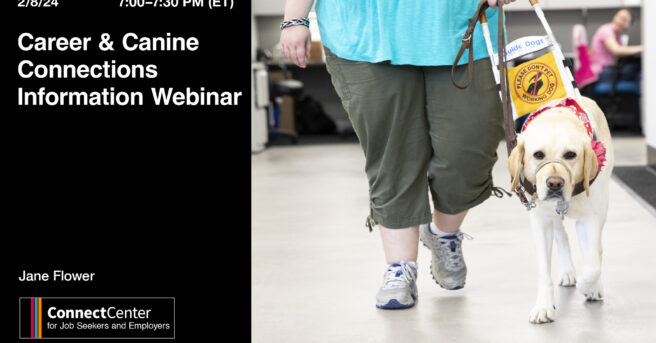
The guide dog is another mobility aid that can help enable people who are blind or have low vision to travel safely. Guide dogs can guide people around obstacles and through crowds, stop at curbs and stairs, and sometimes can even be trained to find a limited number of objects that are within sight when given orders such as “Find the chair,” “Find the door,” or “Find the elevator.” The guide dog user can also train (or “pattern”) the dog to find frequently used landmarks, such as a bus stop pole or a mailbox.
A common misconception is that people who are blind or have low vision and don’t have orientation and mobility (O&M) travel skills can use a guide dog to travel safely and independently; people mistakenly assume that it is the dog that shows the person where to go. This is not true. The person who is blind or has low vision directs the dog; the function and purpose of the dog is to merely guide the person around obstacles and indicate the location of steps and curbs.
Another misconception is that guide dogs indicate when it is safe to cross the street. This is also not true. For example, at a traffic signal, the guide dog does not know when the light changes from green to amber to red. It is the person who determines when it is safe to cross the street and which way to go; the dog then guides the person across the street to reach the other side. Although the dog does not know when it is safe to cross the street, if it sees a car approaching too close, it has been trained to stop or attempt to move the person out of the way.
To get a dog, you must attend a special guide dog school that will assign you a dog and train you to take care of the dog and use it to guide you. All reputable dog guide schools require that applicants demonstrate that they have the skills necessary to travel independently with a cane, including walking safely and efficiently in familiar areas, crossing streets, finding destinations, and being able to problem-solve when disoriented or lost. See Guide Dogs for more information about guide dog schools, organizations, and training.
Visit the Following Online Resources for More Information About Orientation and Mobility Services and Training
www.sauerburger.org — The web site of Dona Sauerburger, M.A., COMS®, Orientation And Mobility Specialist. Dona’s site includes a wide range of articles and information about Orientation and Mobility (O&M) training and services, including O&M for people who are deaf-blind; teaching cane and non-visual skills; street crossing instruction and strategies; and traffic design in some of the Asian countries she has visited.
www.wayfinding.net — The mission of the Institute for Innovative Blind Navigation (IIBN) is to become a global center for the study, promotion, and development of sophisticated wayfinding technologies that have the potential for improving the efficiency and safety of travel for blind individuals. IIBN is a wayfinding think tank organized to gather consumer, public, and professional opinion, formulate proposed policies, and develop and distribute relevant information.
Academy for Certification of Vision Rehabilitation and Education Professionals — Offers professional certification for vision rehabilitation and educational professionals. The Academy also provides a searchable database to locate and check the certification credentials of Low Vision Therapists, Orientation & Mobility Specialists, and Vision Rehabilitation Therapists in your home state.
American Printing House for the Blind Hall of Fame — The Hall of Fame for Leaders and Legends of the Blindness Field honors, preserves, and promotes the achievements of significant practitioners who have shaped the history, philosophy, services, and knowledge of the blindness profession.
Association for Education and Rehabilitation of the Blind and Visually Impaired (AERBVI) — The only international membership organization dedicated to providing support and assistance to the professionals who work in all phases of education and rehabilitation with adults and children who are blind or have low vision. Membership is comprised of more than 4,000 professionals who provide services to people with visual impairments.
History of the White Cane — Describes the history of the white cane, white cane safety laws, and national White Cane day. The National Federation of the Blind designates the third week in May as “White Cane Week.”
The AER Orientation and Mobility Division Web Site — The official web site of the Orientation and Mobility (O&M) Division of the Association for Education and Rehabilitation of the Blind and Visually Impaired. It is the largest and most comprehensive professional organization for O&M specialists in the world.
The White Cane — This Wikipedia article describes the different types of canes, the history of the cane, controversies surrounding the cane, and provides photographs of the different cane types.
Additional Information from VisionAWARE About Vision Rehabilitation Services for Adults with Vision Problems
Visit the following links from VisionAWARE to learn more about eye conditions, vision-related rehabilitation services and professionals, low vision and low vision eye examinations, optical and non-optical low vision devices, and payment options for vision-related rehabilitation:
General Information and Resources
- Eye conditions and treatments
- Products for independent living
- Services for people who are blind or have low vision
Eye Care and Low Vision Services
- Finding the type of eye care professional who is right for you
- What is a low vision examination?
- What are low vision optical devices?
- What are low vision non-optical devices?
Vision-Related Rehabilitation Services and Resources
- An explanation of vision rehabilitation services and professionals
- Paying for vision rehabilitation services
- Self-help and support groups for adults who are blind or have low vision
Also, be sure to visit VisionAWARE’s Question & Answer links for more information on Personal Self-Care, Home Management, Home Modifications, Money and Finances, Home Mechanics, Reading and Writing, Computers and Technology, Employment, and Recreation and Leisure.
You can view or download previous newsletters at Are You AWARE? Newsletter Archive. Maureen Duffy, AWARE’s Editorial Director, can be reached at maureen.duffy@visionaware.org.
Your donation can help us continue to promote self-help vision rehabilitation hints, provide step-by-step adaptive techniques, and disseminate information on services and independent living resources to adults with vision loss, their families and friends, caregivers, and related professionals.
AWARE is a 501(c)(3) non-profit social service organization.
- HOME |
- ABOUT |
- RESOURCES |
- CONTACT US |
- SITE MAP
Copyright ©2011 by American Foundation for the Blind. All rights reserved.